Leave Your Message

China Top 10 CPU Cooler Manufacturers for Global Buyers

China’s Cpu Cooler industry has become an important part of the global PC hardware supply chain. Demand is moving beyond basic aluminum heatsinks. Buyers now compare thermal performance, acoustic output, pump reliability, materials, and after-sales support.

Grand View Research estimates that the global PC liquid cooling market will expand strongly through 2030, supported by gaming PCs, workstations, and data-intensive computing. MarketsandMarkets also identifies rising processor power and compact system design as major cooling drivers. These reports suggest a clear direction. Better chips require more disciplined thermal engineering.

China offers unusual manufacturing depth. Shenzhen, Dongguan, Ningbo, and other industrial centers connect machining, heat-pipe production, fan assembly, packaging, and export logistics. However, factory scale does not automatically prove product quality. Testing methods, warranty records, and independent thermal results matter more than impressive catalog language.

Noctua CEO Roland Mossig has often expressed a practical truth: “There is no such thing as a silent fan.” That principle remains useful when evaluating every Cpu Cooler. A cooler may achieve low temperatures, yet create distracting pump or fan noise. Another model may look premium, but perform poorly inside a restricted case.

This guide examines China’s top 10 Cpu Cooler manufacturers for global buyers. The selection considers engineering capability, production experience, product range, certifications, international distribution, and customer feedback. The ranking is not flawless. Public data is sometimes incomplete, and laboratory results can differ between test platforms. That limitation deserves attention, not concealment. For buyers, the best manufacturer is rarely the cheapest one. It is the supplier that delivers consistent cooling, documented reliability, and responsive support across real-world shipments.
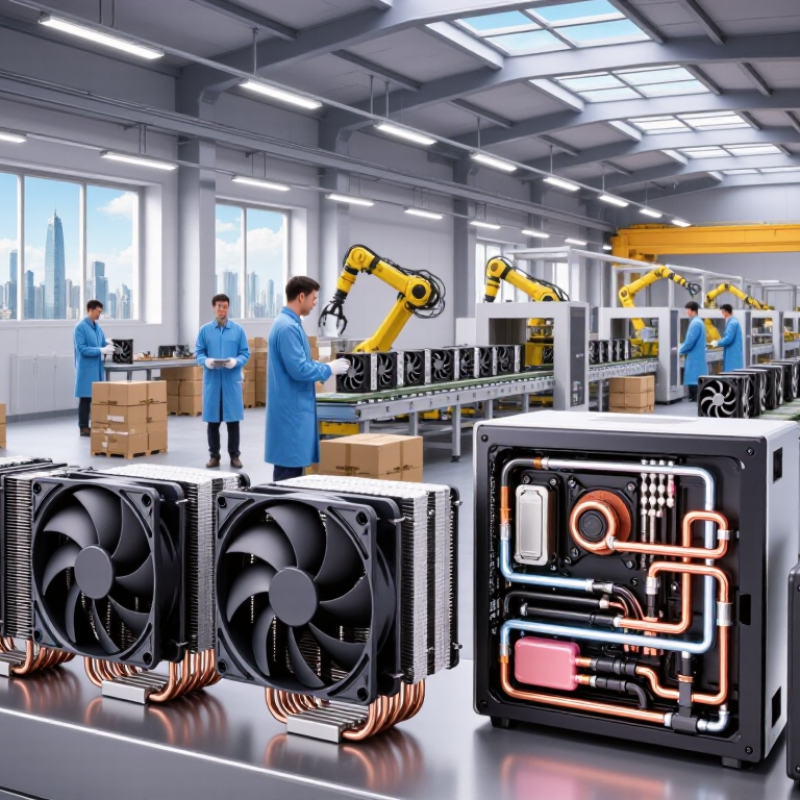
China Top 10 CPU Cooler Manufacturers for Global Buyers

China’s CPU Cooler Manufacturing Landscape and Product Categories

China’s CPU cooler manufacturing landscape covers air, liquid, and specialized thermal solutions. Large tower coolers use copper heat pipes, aluminum fins, and high-static-pressure fans. They suit gaming computers, workstations, and continuous office workloads. Low-profile coolers fit compact cases, although their smaller fin stacks may limit performance under sustained loads.

All-in-one liquid coolers commonly include radiators from 120 to 420 millimeters. Manufacturers assemble pumps, cold plates, tubing, and fans through controlled production lines. Some factories also develop custom cooling systems for servers, industrial computers, and embedded equipment. Their work often includes CNC machining, soldering, leak testing, vibration checks, and thermal testing under different room temperatures.

Quality varies between suppliers.

Experienced buyers should inspect material certificates, fan bearing data, noise measurements, and mounting compatibility. A specification sheet can still hide inconsistent surface finishing or uneven assembly pressure. Reliable manufacturers provide sample testing, traceable batch records, and clear warranty procedures. They also verify socket support before mass production, since platform changes can affect bracket design and clearance. In practice, even a strong factory may need refinement after field feedback. That is normal, but ignored defects can become costly.
How the Top 10 Chinese CPU Cooler Manufacturers Are Evaluated

China Top 10 CPU Cooler Manufacturers for Global Buyers

The top ten Chinese CPU cooler manufacturers should be evaluated through evidence, not catalogue size. IDC reported 262.7 million global PC shipments in 2023, creating strong demand for dependable thermal hardware. However, shipment volume does not prove cooling quality. A serious review should inspect factory experience, engineering staff, automated assembly, and export history. It should also verify ISO 9001 systems and traceable quality records.

Performance deserves the highest weighting. Independent laboratories should measure thermal resistance, peak temperature, noise, pump reliability, and fan lifespan under identical loads. Processor datasheets commonly define maximum junction temperatures near 100°C, but safe operation requires consistent headroom. Small details matter: flat copper contact plates, uniform mounting pressure, sealed tubing, and clean solder joints. Noise should be recorded in decibels, not described as “quiet.”

Market evidence also matters. MarketsandMarkets forecasts the data-center liquid-cooling market to grow from about 4.1 billion dollars in 2024 to 12.8 billion dollars by 2029. This supports checking a manufacturer’s capability with higher thermal loads, although consumer coolers need different testing. A practical score can assign 35% to laboratory performance, 25% to manufacturing quality, 20% to reliability data, and 20% to service and compliance. Warranty response times should be tested with real inquiries. Some evaluations remain imperfect because samples may receive extra inspection. That weakness deserves disclosure.

This evaluation framework uses weighted criteria commonly applied by global buyers when comparing Chinese CPU cooler manufacturers. Thermal performance and build quality receive the highest weights because they directly affect cooling reliability, service life, and system stability.

Top 10 China-Based CPU Cooler Manufacturers for Global Buyers

Top 10 China-Based CPU Cooler Manufacturers for Global Buyers

China-based CPU cooler manufacturers now serve demanding markets with air coolers, liquid systems, and custom thermal assemblies. Grand View Research estimated the global computer cooling market at over USD 5 billion in 2023, with continued growth through 2030. This demand reflects rising processor power, compact workstations, and expanding data-center construction.

The strongest Chinese suppliers usually combine CNC machining, automated assembly, and in-house thermal testing. Buyers should request thermal resistance results, pump lifespan data, fan noise readings, and cold-plate material details. Copper contact plates and high-static-pressure fans remain practical choices for sustained workloads. TÜV Rheinland and ISO quality frameworks can support supplier evaluation, but certificates alone prove little.

Ask for samples.

Production consistency matters. A supplier may deliver an excellent prototype, then vary fin density or paste coverage during mass production. I have seen procurement teams overlook packaging vibration tests, which can damage mounting hardware before installation. The 2024 Omdia cooling market analysis also highlights efficiency and reliability as key purchasing factors. Global buyers should compare ten manufacturers using identical test platforms, ambient temperatures, and processor power limits. That comparison is slower, but far more dependable than trusting catalog numbers.

China Top 10 CPU Cooler Manufacturers for Global Buyers - Top 10 China-Based CPU Cooler Manufacturers for Global Buyers

Rank Anonymous Manufacturer Profile Common Manufacturing Cluster Primary Product Focus Cooling Formats Core Materials and Processes Customization Capability Relevant Quality and Compliance Documents Typical Buyer Applications Recommended Verification Points
1 Profile A
High-volume OEM
Shenzhen–Dongguan, Guangdong Mass-market desktop CPU coolers Tower air coolers; top-flow air coolers Aluminum fin stacks, copper heat pipes, injection-molded fan frames, CNC or stamped base plates Logo-free packaging, fan curves, mounting kits, heatsink dimensions, and color options ISO 9001 certificate; RoHS and REACH material declarations; electrical safety test reports where applicable System integrators, distributors, gaming PC assemblers Thermal resistance data, noise test method, socket compatibility, carton drop-test results
2 Profile B
Liquid cooling specialist
Shenzhen–Huizhou, Guangdong Closed-loop liquid CPU coolers 120 mm, 240 mm, 280 mm, and 360 mm radiator formats Aluminum radiators, copper cold plates, EPDM or rubber tubing, injection-molded pump housings Radiator size, tubing length, pump speed, fan selection, cold-plate design, and firmware options ISO 9001; RoHS and REACH documentation; leakage, pressure, endurance, and EMC test records Gaming desktops, workstation builders, performance PC brands Leakage test duration, pump life rating, coolant compatibility, warranty process, and failure-rate data
3 Profile C
Industrial cooling
Kunshan–Suzhou, Jiangsu CPU coolers for industrial computers and embedded systems Low-profile air coolers; passive heatsinks; heat-pipe assemblies Extruded aluminum, skived fins, copper inserts, vapor chambers, and precision machining Thermal interface geometry, mounting brackets, surface treatment, and enclosure-specific designs ISO 9001; RoHS and REACH declarations; reliability and temperature-cycle test reports Industrial PCs, automation equipment, networking hardware Operating-temperature range, vibration testing, thermal cycling, dimensional tolerances, and assembly drawings
4 Profile D
Copper heat-pipe specialist
Dongguan–Foshan, Guangdong High-performance air coolers Single-tower and dual-tower configurations Sintered or grooved copper heat pipes, copper bases, aluminum fins, soldering, and press-fit assembly Heat-pipe count, fin density, base shape, fan bracket, mounting hardware, and surface finish ISO 9001; RoHS and REACH material records; thermal performance and fan reliability reports Gaming PCs, enthusiast workstations, overclocking-oriented systems Heat-pipe contact quality, fin-stack flatness, maximum supported heat load, and installation clearance
5 Profile E
Compact-form-factor
Ningbo–Hangzhou, Zhejiang Small-form-factor and mini-PC CPU coolers Low-profile air coolers; blower-based cooling modules Aluminum extrusion, copper base plates, thin-gauge fins, compact axial or centrifugal fans Custom height limits, fan connectors, mounting patterns, ducting, and thermal interface materials ISO 9001; RoHS and REACH declarations; acoustic, thermal, and dimensional inspection reports Mini PCs, compact workstations, POS terminals, embedded devices Maximum cooler height, airflow direction, acoustic level, connector pinout, and long-term fan testing
6 Profile F
Server and rack cooling
Shanghai–Suzhou industrial belt Server CPU heatsinks and high-density cooling modules Active heatsinks; vapor-chamber coolers; ducted fan modules Extruded or bonded aluminum, copper vapor chambers, high-static-pressure fans, precision brackets Fan redundancy options, tachometer output, hot-swap support, and airflow duct customization ISO 9001; RoHS and REACH documentation; reliability, vibration, and thermal-load test reports Rack servers, storage systems, telecom equipment, edge-computing platforms Airflow at system pressure, fan failure behavior, operating altitude, service life, and mounting retention
7 Profile G
OEM/ODM design house
Xiamen–Quanzhou, Fujian Custom CPU cooling assemblies for private-label products Air coolers, liquid coolers, and hybrid thermal modules Aluminum and copper assemblies, die casting, stamping, CNC machining, brazing, and assembly testing End-to-end engineering, CAD development, prototypes, tooling, packaging, and production transfer ISO 9001; RoHS and REACH files; first-article inspection and product validation records Private-label distributors, electronics manufacturers, computer brands Engineering change control, tooling ownership, prototype lead time, minimum order quantity, and inspection plan
8 Profile H
Fan-integrated module
Shenzhen–Zhongshan, Guangdong CPU cooler and fan-module assemblies Axial-fan tower coolers; ducted air modules; PWM-controlled systems Aluminum heatsinks, copper heat pipes, fluid-bearing or sleeve-bearing fans, injection-molded components Fan blade design, PWM range, connector type, LED-free configurations, and acoustic tuning ISO 9001; RoHS and REACH material records; fan balance, noise, airflow, and endurance tests Desktop computers, industrial controllers, consumer electronics Airflow and static-pressure curves, bearing type, start-up voltage, PWM response, and acoustic test conditions
9 Profile I
Thermal interface integrator
Wuxi–Changzhou, Jiangsu CPU cooling kits with thermal interface materials Air coolers, cold plates, thermal pads, and pre-applied thermal grease solutions Copper or aluminum cold plates, graphite or silicone-based interface materials, stamping and precision grinding Thermal paste selection, pad thickness, pre-application, packaging shelf-life, and assembly instructions ISO 9001; RoHS and REACH declarations; thermal conductivity and aging test reports OEM assembly lines, workstation manufacturers, electronics distributors Thermal impedance, pump-out resistance, shelf life, storage conditions, and material safety documentation
10 Profile J
Export-oriented supplier
Yiwu–Ningbo, Zhejiang Standard CPU cooling products for international distribution Entry-level air coolers; universal mounting kits; replacement fans Stamped aluminum fins, copper contact plates, standard fan assemblies, powder coating, and retail packaging Packaging artwork, bundled accessories, multilingual manuals, carton configuration, and shipment labeling ISO 9001 where applicable; RoHS and REACH declarations; pre-shipment inspection records Importers, e-commerce sellers, regional computer-parts distributors Minimum order quantity, lead time, spare-parts policy, packaging dimensions, export documents, and after-sales support

Key Specifications, Certifications, and Customization Options

China Top 10 CPU Cooler Manufacturers for Global Buyers

Key Specifications, Certifications, and Customization Options

Reliable CPU cooler sourcing starts with measurable performance, not attractive product photos. Compare thermal design power, airflow, static pressure, fan speed, and noise levels. A cooler rated for 180 watts may perform differently inside a compact case. Check the test method and ambient temperature.

Socket compatibility deserves close attention. Confirm support for current desktop platforms, mounting pressure, cooler height, and memory clearance. Air coolers should specify heat-pipe quantity, base material, and fin structure. Liquid models need radiator size, pump speed, tubing length, and leak-testing records. Small details matter.

Very small details matter.

For international purchasing, request evidence of CE, RoHS, REACH, and ISO 9001 compliance where applicable. Certificates should match the factory, product category, and current production model. I have seen documents copied into presentations without clear traceability. That is a warning sign. Ask for laboratory reports, inspection records, and sample units before approving volume orders.

Customization may include fan diameter, LED control, cable length, packaging, mounting kits, surface finish, and private-label documentation. Confirm minimum order quantities, tooling fees, sample charges, and replacement-part support in writing. A customized design can improve installation, but it may also reduce compatibility. That trade-off deserves honest review. Test noise after installation, not only in an open laboratory.

Import, Quality Control, and Supplier Selection Considerations

China Top 10 CPU Cooler Manufacturers for Global Buyers

Import, Quality Control, and Supplier Selection Considerations

For global buyers, comparing China’s top ten CPU cooler manufacturers requires more than checking unit prices. Import planning starts with product specifications, tariff classification, carton dimensions, and destination-market requirements. Request drawings showing base flatness, heat-pipe layout, fan bearing type, noise testing, and rated thermal limits. A supplier that answers quickly but vaguely can create expensive delays. Ask for evidence.

Quality control should operate before mass production. Review a pre-production sample, then approve a signed golden sample with photographs and measurable tolerances. During inspection, check fin deformation, solder joints, fan vibration, cable connectors, mounting pressure, and packaging drop resistance. Ask for batch records, material certificates, inspection reports, and corrective-action history. Factory audits should confirm calibration dates and traceability. Samples can mislead. One polished unit never proves stable output.

Supplier selection also depends on communication and after-sales discipline. Test response times with technical questions, revision requests, and a simulated defect claim. Confirm lead times, minimum order quantities, spare-part policy, warranty scope, and Incoterms in writing. Use a purchase contract with acceptance criteria, inspection rights, and remedies for nonconforming goods. My sourcing reviews have exposed weak points after approval, especially when engineering and sales teams interpret “quiet” differently. Define acoustic limits in decibels, measured at a stated distance and test condition. Leave room for correction. A cheaper quote may hide rework, customs friction, or inconsistent fan quality.