Leave Your Message

Why Choose Air Cooling for Industrial Equipment?

Industrial equipment rarely fails because of one dramatic problem. More often, heat accumulates quietly inside a control cabinet, compressor, motor, or production line. Surface temperatures rise. Lubricants thin. Sensors begin to drift. Air Cooling offers a practical way to control this heat without adding water circuits, pumps, or complex liquid infrastructure.

Professor Yunus A. Çengel, a widely cited heat-transfer authority, explains, “Heat transfer is thermal energy in transit due to a temperature difference.” This principle is simple, but its application requires careful engineering. Air Cooling systems use fans, filters, ducts, heat exchangers, or natural convection to move unwanted heat away from critical components. In a factory, that may mean guiding cool air across a motor housing while preventing dust from entering its bearings. Small details matter.

Air Cooling is not automatically the best choice. It can struggle in dusty workshops, humid environments, or areas with limited airflow. Fan noise, filter maintenance, and energy consumption also deserve attention. The choice is not flawless. That matters.

However, well-designed Air Cooling can provide reliable temperature control, easier maintenance, and lower installation complexity. Engineers should examine heat load, ambient temperature, enclosure rating, airflow paths, and service conditions before selecting equipment. A clean filter may protect performance today, but a neglected filter can defeat the entire system tomorrow. This guide explores why industries continue choosing Air Cooling, where it performs well, and which limitations deserve honest consideration.
Why Choose Air Cooling for Industrial Equipment?

How Air Cooling Works in Industrial Equipment

Air cooling removes heat by moving ambient air across a heated surface. Inside industrial equipment, fans push air through fins, ducts, or heat exchangers. The air absorbs heat, then leaves through an exhaust path. It is simple, visible, and easy to inspect.

According to the U.S. Department of Energy’s Motor Systems Market Assessment (2021), motor-driven systems consume about 69% of industrial electricity in the United States. Fan selection therefore matters. An oversized fan may waste power, while a weak fan can create dangerous hot spots. Fins increase surface area. Airflow carries heat away from motors, control cabinets, compressors, and power electronics. Filters protect components, but blocked filters sharply reduce cooling performance.

The International Energy Agency’s The Future of Cooling (2018) projects that global cooling energy demand could more than triple by 2050. Air cooling is not automatically efficient. Ambient temperature, dust, humidity, and enclosure design change its results. A practical inspection may find clean fans but poor airflow around the cabinet. That is an easy detail to miss. Engineers should measure inlet temperature, outlet temperature, airflow, and noise under real operating loads. The basic heat relationship is straightforward: more airflow and a larger temperature difference usually remove more heat. Yet excessive airflow can increase noise, vibration, and maintenance needs. The design still deserves questioning.

Why Choose Air Cooling for Industrial Equipment?

Air cooling removes heat by moving air across hot components. This chart estimates heat-removal capacity at different airflow rates, assuming standard air density of 1.20 kg/m³, a specific heat capacity of 1.005 kJ/kg·K, and a 10°C air temperature rise. Higher airflow increases the mass of air available to carry heat away.

Key Benefits of Air Cooling Systems

Air cooling systems offer a practical way to control heat in industrial equipment. They use fans, heat exchangers, and airflow instead of liquid coolant. This design reduces the risk of leaks near motors, control panels, and sensitive components. It also avoids pumps, reservoirs, and many plumbing connections. Maintenance can become simpler.

In daily plant operations, technicians often value quick access to cooling parts. Filters can be inspected, fans tested, and airflow measured during scheduled service. Air systems also reduce water consumption, which matters in dry regions or facilities with limited water access. Installation is often flexible because the equipment does not need a continuous coolant supply. Noise remains a concern. Poor fan selection can disturb nearby workers. Careful acoustic planning is essential.

Air cooling can support stable equipment performance when the surrounding temperature stays within the design range. Clean air is equally important. Dust buildup on fins or filters restricts airflow and increases operating temperature. Reliable monitoring should include temperature readings, fan condition, filter pressure, and unusual vibration. These checks provide useful evidence before a failure develops.

The choice is not always perfect. Very hot environments may reduce cooling capacity, and large machines may require extra airflow or a hybrid design. Engineers should compare heat load, space, maintenance skills, energy use, and local climate before selecting a system. Small oversights can become expensive.

Why Choose Air Cooling for Industrial Equipment? - Key Benefits of Air Cooling Systems

Evaluation Dimension How Air Cooling Works Key Benefit Typical Data or Practical Indicator Main Considerations
System Simplicity Fans or blowers move ambient air across heat sinks, coils, fins, or equipment surfaces to remove heat. Fewer components than liquid-based cooling systems can simplify installation and maintenance. No coolant pump, reservoir, piping circuit, or liquid-to-air heat exchanger is required in a direct-air design. The airflow path must be correctly designed to prevent recirculation and stagnant hot spots.
Operating Cost Electrical energy is mainly used by fans, blowers, or air-handling equipment. Can provide economical heat removal where the required heat load and ambient conditions are moderate. Energy consumption depends on airflow volume, pressure drop, fan efficiency, operating hours, and motor efficiency. Dirty filters, blocked vents, and undersized ducts increase pressure drop and fan power demand.
Maintenance Requirements Air passes through filters, grilles, ducts, heat sinks, or coils before leaving the cooled area. Routine service is generally straightforward and focuses on airflow-related components. Common tasks include filter inspection, dust removal, fan-bearing checks, belt inspection, and electrical connection checks. Maintenance intervals should be shortened in dusty, oily, humid, or corrosive environments.
Leak and Contamination Risk Heat is transferred directly to moving air without circulating liquid coolant. Eliminates coolant leakage, fluid replacement, and water-treatment requirements in direct-air systems. There is no liquid circuit to leak; protection against dust and moisture still depends on enclosure and filtration design. Open-air systems may draw contaminants into equipment if filtration and enclosure protection are inadequate.
Installation Flexibility Cooling air can be supplied through axial fans, centrifugal blowers, ventilation ducts, or cabinet air-conditioning units. Suitable for equipment layouts where ventilation access and exhaust routing are available. Design must account for inlet temperature, available space, airflow direction, duct length, and pressure losses. Hot exhaust air should not be discharged near the cooling-air inlet.
Temperature Control The cooling capacity depends on air mass flow, specific heat, and the temperature rise of the air. Provides effective temperature control when ambient air is sufficiently cooler than the equipment heat source. A basic heat-balance relationship is Q = ṁ × Cp × ΔT, where Q is heat removed, ṁ is air mass flow, Cp is air specific heat, and ΔT is air temperature rise. Performance decreases as ambient temperature rises; heat-sensitive equipment may require conditioned air.
Noise and Vibration Fans and blowers generate airflow through rotating components. Variable-speed drives, correctly selected fans, and acoustic treatment can reduce operating noise. Noise is affected by fan speed, blade design, airflow turbulence, motor type, bearings, and duct configuration. Noise limits should be checked against workplace requirements and equipment-location constraints.
Environmental Suitability Ambient or conditioned air removes heat from motors, control cabinets, power electronics, compressors, and other industrial equipment. Works well in clean or moderately contaminated areas when filtration and enclosure protection are properly selected. Design factors include dust concentration, humidity, corrosive gases, altitude, ambient temperature, and required enclosure rating. Sealed or filtered systems are preferred where airborne particles, oil mist, or corrosive substances are present.
Typical Applications Airflow is directed over heat-generating components or through ventilated enclosures. Provides a practical solution for many low-to-medium heat-load industrial applications. Common uses include electric motors, variable-frequency drives, control cabinets, generators, transformers, compressors, and electronic assemblies. High heat flux, limited installation space, or very precise temperature control may require liquid or hybrid cooling.

Note: Performance values and maintenance intervals vary with equipment design, heat load, ambient conditions, airflow rate, filtration, and operating environment. Final selection should be verified through a thermal and airflow assessment.

Industrial Applications Best Suited to Air Cooling

Why Choose Air Cooling for Industrial Equipment?

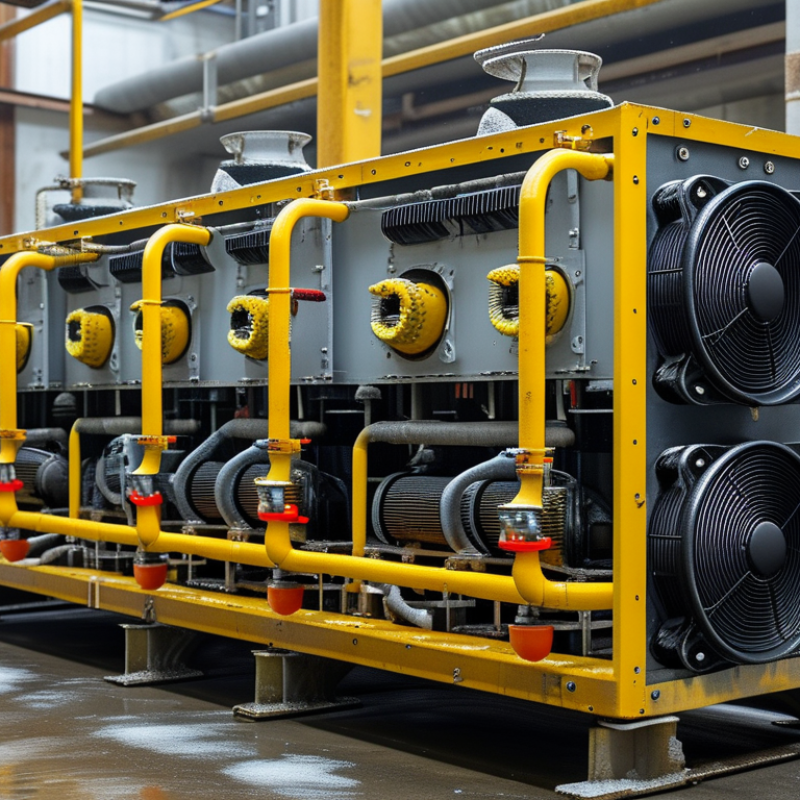
Industrial applications best suited to air cooling usually have moderate heat loads, limited water access, or frequent maintenance needs. Electrical control cabinets, dry-type transformers, air compressors, generators, and outdoor power units often fit this profile. Air moves across fins or coils, removing heat without pumps, treatment chemicals, or cooling-tower blowdown.

The International Energy Agency reported that cooling represented nearly 10% of global electricity use in 2016. That figure concerns buildings, but it highlights a wider concern: cooling systems must avoid unnecessary energy demand. In factory inspections, technicians often find dust-packed filters and blocked airflow before they find a failed fan. Small details matter. Air cooling works best when equipment has clear intake space, clean filters, and controlled ambient temperatures.

Dry environments are particularly suitable. A packaging line with sensitive electronics may benefit from sealed air-to-air heat exchangers, while a remote generator may need only forced ventilation and finned surfaces. ASHRAE’s Handbook—HVAC Systems and Equipment stresses airflow, heat-transfer surfaces, and contaminant control when selecting cooling equipment. Water cooling can remove more heat in compact spaces, though it adds leak risks and water management. That trade-off is easy to underestimate. Air cooling is not automatically efficient; undersized fans can run continuously and waste power. Engineers should verify heat load, enclosure rating, noise limits, and seasonal temperature extremes before specifying it.

Factors for Selecting an Air Cooling Solution

Why Choose Air Cooling for Industrial Equipment?

Selecting an air cooling solution starts with the equipment’s real heat load, not its brochure rating. Measure operating temperature, power consumption, enclosure size, and the hottest surrounding conditions. A factory floor near furnaces may require stronger airflow than a clean indoor room. Small details matter.

Air is often practical, accessible, and easier to service than liquid systems. Fans, filters, ducts, and heat exchangers can support steady operation without complex plumbing. However, airflow must reach the actual heat source. Poor cabinet layout can create stagnant pockets, even when the fan appears powerful. It happens more often than expected.

Dust and moisture deserve careful attention. In a woodworking area, filters may clog quickly and reduce cooling performance. In humid environments, condensation can damage electrical components. Select suitable filtration, enclosure protection, and drainage methods. Noise also matters, especially near operators. A cooling system that protects machinery but creates constant disturbance may not be a successful choice.

Energy use should be evaluated across the equipment’s service life. Oversized fans waste power, while undersized systems increase thermal stress and shorten component life. Variable-speed control can respond to changing loads, but it adds controls that require testing and maintenance. Leave room for inspection. Sensors should monitor temperature and airflow, not merely display reassuring numbers.

A reliable decision combines thermal calculations with field observation. Record seasonal temperatures, cleaning intervals, and previous failure patterns. One assumption may be wrong. Recheck it before installation. This practical evidence helps determine whether air cooling offers enough capacity, maintainability, and resilience for the application.

Air Cooling Maintenance and Performance Considerations

Air cooling is often chosen for industrial equipment because it uses ambient air instead of pumps, coolant lines, or complex fluid circuits. This can simplify installation and reduce leak-related risks around electrical cabinets and rotating machinery. Yet air cooling is not maintenance-free. Dust, oil mist, blocked vents, and high room temperatures can quickly reduce heat-transfer performance. In a workshop, a thin gray layer on a filter may look harmless. It is not.

Maintenance should follow measured conditions, not guesswork. Inspect filters, fan blades, heat sinks, ducts, and seals at scheduled intervals. Check unusual vibration, rising outlet temperature, and changes in fan noise. A temperature log helps reveal slow deterioration before an overload occurs. Clean components with methods approved for the equipment; careless compressed air can push debris deeper inside.

Also verify that intake and exhaust paths remain clear, especially near walls or stored materials. I have seen operators replace a fan when a blocked grille caused the real problem. That mistake costs time.

Tips: Keep spare filters available. Record temperatures under similar loads. Clean before visible buildup becomes heavy. Review airflow after every layout change. Leave clearance around vents. Small details matter. When performance still falls, compare ambient temperature, load, airflow, and electrical readings together. Air cooling can be dependable, but only when its environment is treated as part of the system.